I love taking an old worn out chair, sofa, ottoman, or anything that needs to be reupholstered, bring it back to life and make it look new again. I especially love to see the customers face when they see grandpa's old chair for the first time after the work is complete. Through the years I have actually witnessed a few customers that were emotional over it and say something like 'Grandpa would just love this'. That's when I know I've done a good job.
I enjoy doing upholstery work if it's furniture, a boat seat, or someone's worn out airplane seat. I love it all but I enjoy working on old antiques the most. Because those old antique chairs and sofas were hand crafted by those who I consider to be a master craftsman. And for me it's always been an honor to take their work and bring it back to life!
Lately, it seems like I keep running into people that claim to do upholstery work. That's great but I can't help wondering if they really know the
difference between upholstery and recovering? Do you know the difference? Basically, recovering furniture is when you take the old cover off and replace it with a new one. That's recovering not upholstering. Upholstering is when you strip a chair all the way down to the wood frame and rebuild the chair. Tighten and reglue any lose joints, reinstalling new webbing, new springs if needed, retying the springs, new padding and new fabric. That's what I do here at Silver Threads Upholstery.
I will be happy to give you a quote but remember you never know what's underneath the covering. It's like the old saying 'Don't judge a book by it's cover!' For example take this 1880 's Eastlake chair in the photo. Looking at it and sitting in it you would think it was in pretty good condition. Just a few stains, missing tacks, padding worn, and the springs felt weak. Like most old furniture like this they have been reupholstered several times.
I enjoy doing upholstery work if it's furniture, a boat seat, or someone's worn out airplane seat. I love it all but I enjoy working on old antiques the most. Because those old antique chairs and sofas were hand crafted by those who I consider to be a master craftsman. And for me it's always been an honor to take their work and bring it back to life!
Lately, it seems like I keep running into people that claim to do upholstery work. That's great but I can't help wondering if they really know the
difference between upholstery and recovering? Do you know the difference? Basically, recovering furniture is when you take the old cover off and replace it with a new one. That's recovering not upholstering. Upholstering is when you strip a chair all the way down to the wood frame and rebuild the chair. Tighten and reglue any lose joints, reinstalling new webbing, new springs if needed, retying the springs, new padding and new fabric. That's what I do here at Silver Threads Upholstery.
I will be happy to give you a quote but remember you never know what's underneath the covering. It's like the old saying 'Don't judge a book by it's cover!' For example take this 1880 's Eastlake chair in the photo. Looking at it and sitting in it you would think it was in pretty good condition. Just a few stains, missing tacks, padding worn, and the springs felt weak. Like most old furniture like this they have been reupholstered several times.
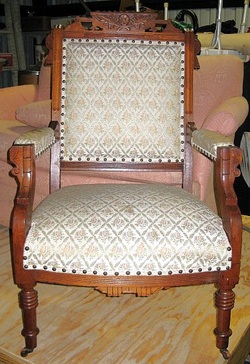
Let's take a look at what I found.
The damaged wood in the last three photo's is the bottom back of the chair. What a surprise! I really wasn't expecting to find that kind of damage. The photo's didn't show it, but someone in the past tried to fill all those gaps and holes with glue! How can you glue what is not there? I could have made a new piece for the seat frame but I wanted to keep as much of the original wood as I could. So I cut out the damaged wood and installed a new oak strip so I would have something strong to staple into.
With a little TLC, repairs, and new fabric, what a beautuful old chair! This is just an example of what you can run into when having an old antique reupholstered. I don't usually see damage to this extreme. But damage like this can change a quote. It's a lot more work to repair damage like this. Regardless of what I'm working on I try to do the best work I can. I do have fabric & vinyl samples to show you at discounted prices or I can work with your fabric. If you choose to shop for bargan fabrics please look it over closely before purchasing. Many times these fabrics have flaws that have to be cut around making the work more difficult incurring additional charges referred to as a cutting fee. If I can help you in anyway please call me.
I have hundreds of fabric samples to show you. If you would like to look at fabric samples from Barrow Industries click on the link. If you find a pattern you would like to look at call me. http://barrowindustries.com/webConn1a.asp
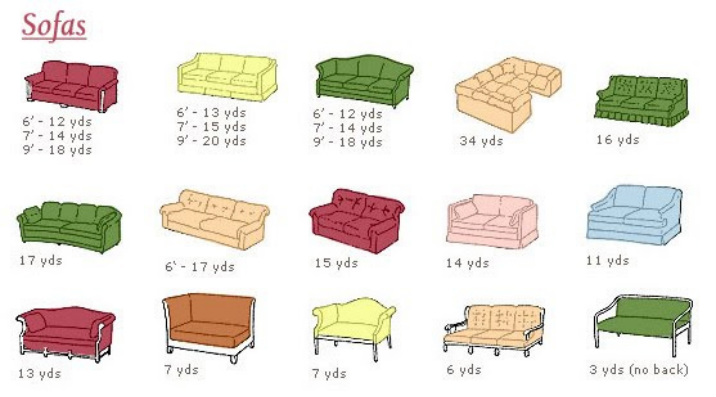
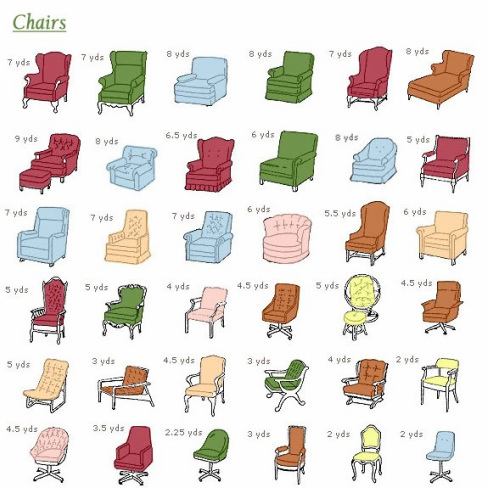
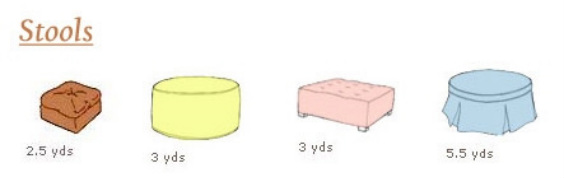
Hopefully the chart below will be of help to you in figuring how many yards of fabric you will need.
Note: Yardage estimates on the chart below are figured on solid patterns and does not account for things like, but not limited to: Cording being cut on the Bias, material with a repeat pattern in one or both directions, Head or arm covers, loose back cushions instead of attached cushions, self-lined skirt, material railroaded or not, and others.
These estimated yardages are based on basic solid fabrics, doing a very basic upholstery job. Please adjust yardages for your specific upholstering style, material being used and design difference in the exact piece you are covering.
I have hundreds of fabric samples to show you. If you would like to look at fabric samples from Barrow Industries click on the link. If you find a pattern you would like to look at call me. http://barrowindustries.com/webConn1a.asp
Hopefully the chart below will be of help to you in figuring how many yards of fabric you will need.
Note: Yardage estimates on the chart below are figured on solid patterns and does not account for things like, but not limited to: Cording being cut on the Bias, material with a repeat pattern in one or both directions, Head or arm covers, loose back cushions instead of attached cushions, self-lined skirt, material railroaded or not, and others.
These estimated yardages are based on basic solid fabrics, doing a very basic upholstery job. Please adjust yardages for your specific upholstering style, material being used and design difference in the exact piece you are covering.
Be sure to check out my "Project Blogs" page to see what project I'm working on http://www.silverthreadsupholstery.com/project-blogs.html

© Copyright 2016 Silver Threads Upholstery
